Summarize this page with
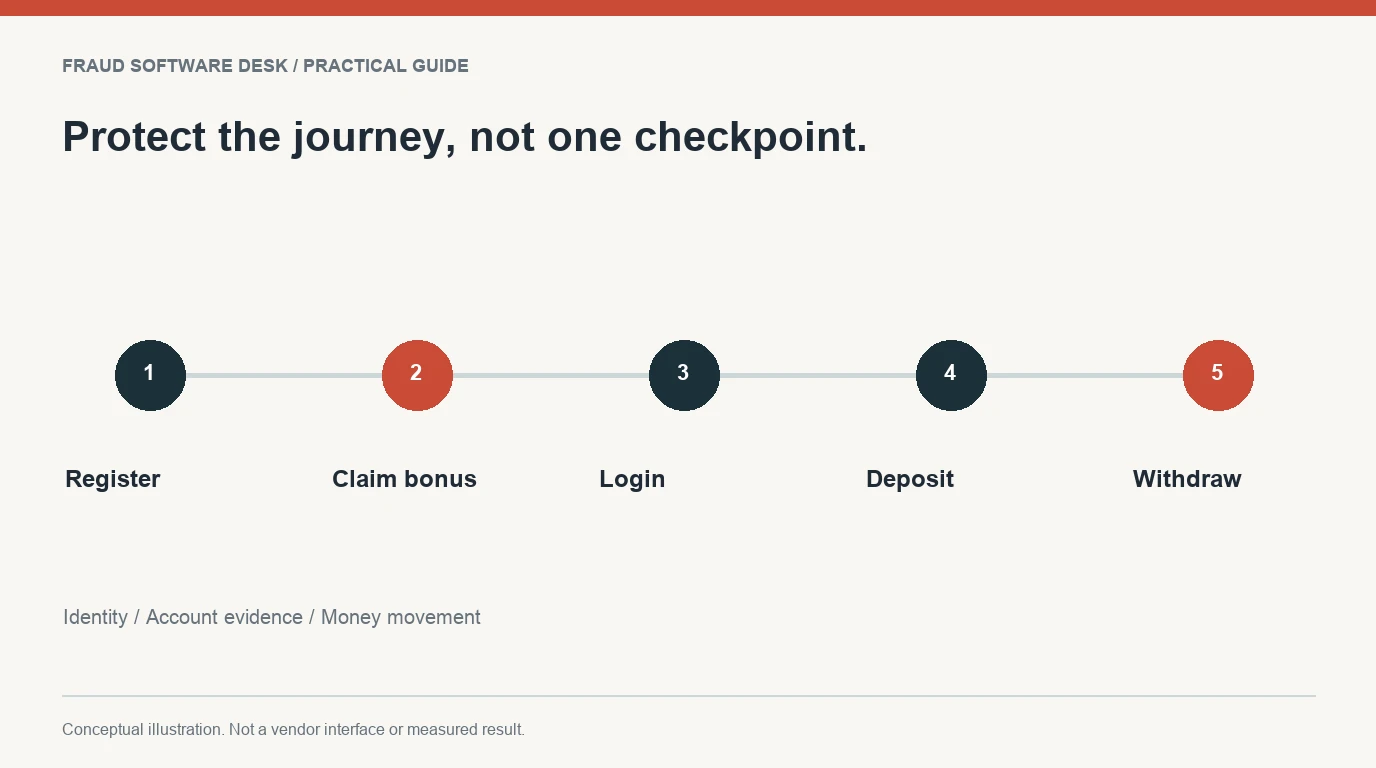
An iGaming fraud prevention stack needs to connect registration, bonuses, account access, deposits and withdrawals. Document checks and payment screening address important parts of that journey, but repeated benefit claims and account abuse can begin before a card transaction. Choose evidence and operating controls at each stage rather than buying one broad fraud label.
- 1Registration and bonus
- 2Session and payment
- 3Withdrawal review
Map the player journey and benefit rules
Define the account, session, device and entitlement units used by the product. A welcome benefit may be limited under business rules that differ from a deposit or withdrawal policy. Write those rules precisely enough that legitimate shared-household behavior can be distinguished from repeated prohibited claims.
Keep registration, authentication, game activity and money movement as separate events with timestamps. The investigation can then follow a sequence instead of inferring coordination from a snapshot. The account-ring guide explains typed relationships and legitimate controls.
Connect device and account evidence early
A device and network layer can add continuity and current masking context at signup and login. Account relationships help reveal repeated claims across apparently unrelated registrations. Evaluate authorized test cases alongside legitimate households and returning users on new devices.
ShieldLabs combines device/network evidence with risk for visitors, users, devices and IPs. Its ready-made Multi-accounting, Account sharing, Impossible travel and Account takeover findings fit several account-risk questions. Those findings do not replace every identity, payment or operating requirement in an iGaming stack.
Keep identity and compliance requirements distinct
Age, identity, location and financial-crime obligations depend on the operator’s regulated activity and jurisdiction. Scope the necessary specialist products and verified requirements with the responsible team. A device or VPN risk result is not itself proof of physical presence or completion of an identity-verification process.
SEON’s current platform combines digital footprint, device and broader identity/AML offerings. Verify the products in the selected plan. Do not assume that a fraud-prevention entry package includes all compliance workflows because they appear in the same navigation.
Treat deposits and withdrawals as different actions
| Stage | Example evidence | Operating question |
|---|---|---|
| Registration | Account, device and current network | Is the registration linked to relevant prior activity? |
| Bonus claim | Entitlement and claim history | Does this action meet the actual benefit terms? |
| Login | Authenticated account and environment changes | Is access consistent with the account’s history? |
| Deposit | Payment attempt and account context | Does the payment introduce a supported fraud concern? |
| Withdrawal | Recipient, changes and activity sequence | Is the money-movement request consistent and authorized? |
The withdrawal deadline can be different from a login deadline. Preserve recent account changes and relevant authentication evidence when evaluating a new destination. Record why a request entered review and what additional evidence resolved it.
Evaluate full-journey products honestly
Sift’s iGaming article describes account, device and payment considerations across the journey. Sardine’s payment-fraud product describes multiple money-movement rails and device/behavioral context. Confirm the integration and entitlement for the operator’s actual methods and events.
A broad platform can reduce disconnected workflows, but it still needs input data and operating ownership. A focused account-risk product can be faster to evaluate for one specific problem. Use the alternatives page to decide which buying job is primary.
Test both repeated abuse and legitimate clusters
Create permitted test identities and scripted event histories for evaluation. Include repeated claims from linked accounts, unusual account access and a changed withdrawal destination. Keep the cases authorized and separate from live money movement.
Include shared household hardware, corporate networks, mobile IP changes and valid use of several devices. A system that finds repeated activity while restricting many legitimate players may need a different operating response. The false-positive guide provides separate denominators for flagged, reviewed and restricted cases.
Define the review and recovery loop
Assign an owner to each case type. Keep the original evidence, action and final outcome. Distinguish a suspected link from confirmed prohibited behavior. Allow correction when a household or device association was interpreted incorrectly.
Measure bonus loss, confirmed unauthorized activity, payment loss, review workload and legitimate completion separately. Avoid describing the entire value of withheld withdrawals as fraud prevented. A valid impact estimate needs comparable cohorts and a clearly stated outcome definition.
Budget the events and required products
Count the assessments planned at registration, login, claims, deposits and withdrawals. Add specialist identity or compliance scope, operational review and engineering work. Compare actual billing units rather than placing per-identification and per-order prices side by side without context.
The cost guide, API integration guide and checker directory provide the next steps from a shortlist to a controlled evaluation.
FAQ
Can KYC alone stop bonus abuse?
Identity checks answer one part of onboarding. Repeated entitlement claims can require device, account and activity context as well as precise benefit rules.
Does a VPN result prove a player is in a prohibited location?
No. A network classification is not proof of physical presence. Scope specialist location requirements separately and inspect the current action context.
Should all shared-device accounts be restricted?
No. Shared households and hardware can be legitimate. Evaluate the relevant rules, event sequence and corroborating evidence, with a review and recovery path.
Continue reading
- How to detect online fraud across the customer journey
- Fraud detection: rules, machine learning and device intelligence
- How to integrate a fraud detection API safely
Compare all nine tools or read the complete deployment guide.