Summarize this page with
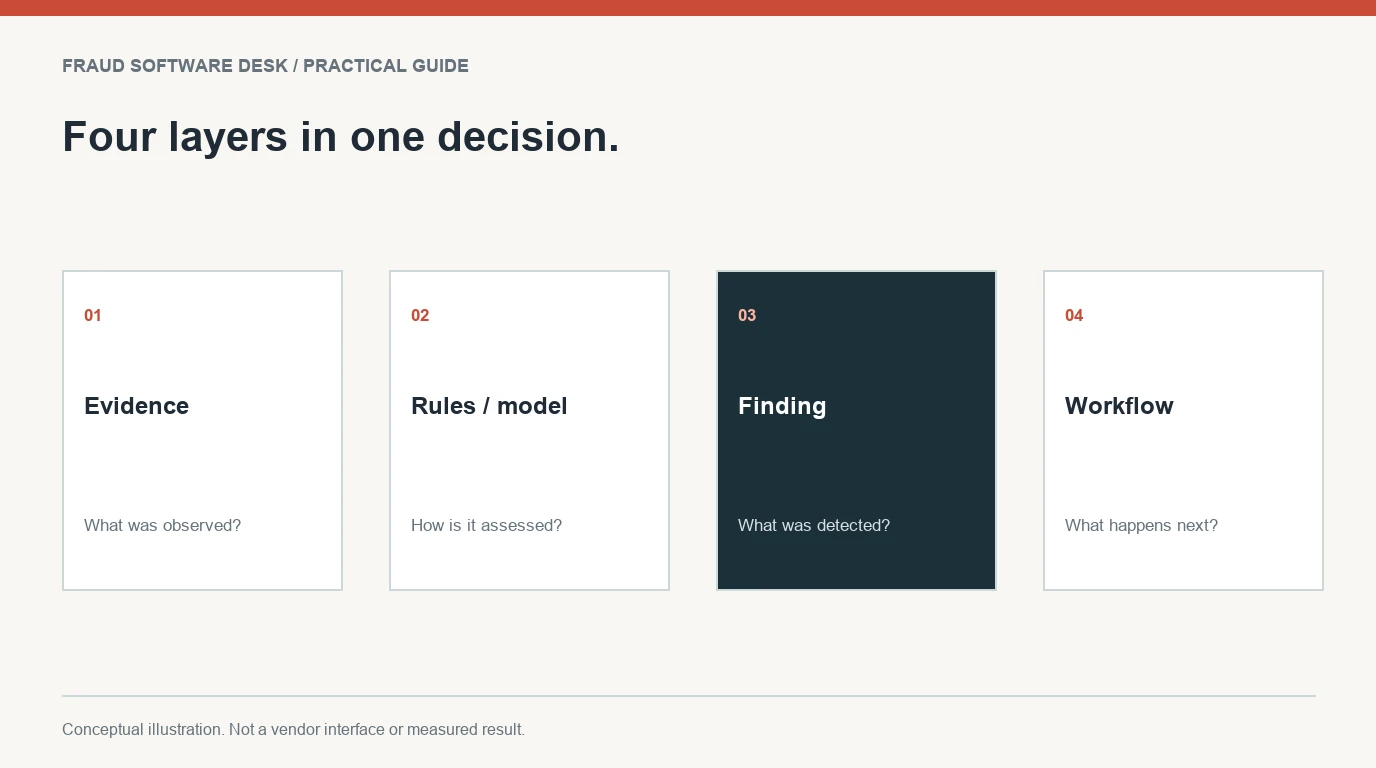
A rule, a fraud model and a device identifier are different parts of a decision. Rules express conditions, machine learning estimates patterns, device intelligence provides identity and environment evidence, and a workflow handles the response. Compare fraud detection methods by the job each one does before asking which is best.
- 1Collect evidence
- 2Assess the risk
- 3Route the action
Start with evidence, assessment and action
A device signal is an observation. A risk score is an assessment of available observations. A blocked signup is an action taken after an assessment. Mixing those layers makes an evaluation confusing: a product with many attributes may still require the buyer to build the decision process.
Describe the full path on paper. Which system collects the data? Which system evaluates it? Who owns the response? Which record explains what happened? The integration guide turns those questions into an event and trust-boundary design.
What a fraud rule does
A rule applies an explicit condition to supplied data. For example, a business might review a sensitive account change when a required verification is missing. The logic can be understandable, but it still depends on reliable data, a maintained definition and an appropriate response.
Rules become hard to maintain when their purpose is undocumented or overlapping exceptions accumulate. Inventory the protected action and reason before copying a large rule set. A condition that helped a card checkout may be inappropriate for a signup with no payment history.
What a model adds
A model can combine relationships that are difficult to express as one hand-written condition. Evaluation still requires known outcomes, a defined population and attention to changing behavior. A score with a higher numerical range is not automatically a more precise prediction.
Sift’s Score API documentation separates risk by abuse type. Its explainability article describes a risk summary and contributing signals. Inspect the actual output rather than assuming a model must be either fully transparent or entirely opaque.
What device intelligence contributes
Device intelligence helps recognize an environment, examine integrity and connect activity. Current network observations can also reveal inconsistent or masked connection context. These are useful inputs for both ready-made detections and broader scoring systems.
ShieldLabs combines 300+ device, network and behavioral signals with risk and account-abuse findings. That addresses a different purchasing need from buying only a client-side hash. The useful question is whether the required device and account context arrives in a form the team can use at its protected action.
A repeated identifier does not identify a natural person. A family laptop can legitimately serve multiple accounts; one customer can use several devices. Include those cases in the test set rather than treating them as edge conditions discovered after launch.
Compare the operating responsibilities
| Layer | What it supplies | What the buyer should verify |
|---|---|---|
| Collection and device intelligence | Identity, environment and connection observations | Scope, availability, integrity and event association |
| Rules | Explicit conditions and policy logic | Ownership, overlap, versioning and exception handling |
| Models | Pattern-based assessment | Relevant outcomes, explanation and performance by segment |
| Ready-made detections | A defined finding for an abuse scenario | Supported scenario, context and delivery fields |
| Workflow | Routing, review or enforcement | Time budgets, customer recovery and final action history |
The layers can coexist. A team may use a ready-made account-risk finding, a payment model and a business-specific review rule. Buying one does not remove the need to understand how they interact.
Ask what a reviewer can explain
Request an ordinary legitimate example, a confirmed abuse example and an ambiguous one. For each, inspect the returned reasons, available history and final action. A concise score reason is different from a complete mathematical reconstruction of a model; decide which explanation the operational role actually needs.
SEON’s platform FAQ describes rules, lists, models and device/digital-footprint data in one scoring process. The relevant review distinguishes entry-plan access from broader workflows. Do the same entitlement check for every vendor.
Keep the evaluation grounded in outcomes
Compare the same action cohort and retained outcomes. Look for excessive friction, missing data and failed event association as well as caught fraud. Do not improve an audit score by adding data the deployed product cannot supply.
Use the measurement guide for precision, recall and legitimate-user restrictions. Use the software comparison for current product scope. The most useful stack is one that the team can integrate, explain and operate at the required action deadline.
FAQ
Does machine learning replace fraud rules?
Not necessarily. A model can supply a risk assessment while rules express operational policy or route a case. Compare the responsibilities and maintenance work of the proposed stack.
Is a device fingerprint a fraud score?
No. An identifier supplies continuity under a defined scope. A fraud assessment uses current evidence and context to evaluate the action.
Can ready-made account detections reduce rule maintenance?
They can reduce the work needed to assemble a supported abuse finding from raw attributes. Confirm the actual scenarios, fields and integration rather than assuming they cover every business policy.
Continue reading
- How to evaluate fraud detection and false positives
- How to integrate a fraud detection API safely
- How to detect fraud rings across accounts and events
Compare all nine tools or read the complete deployment guide.