Summarize this page with
Fraud ring detection connects repeated behavior across accounts and events. A useful investigation starts with typed relationships between accounts, devices, sessions and payment references, then asks whether the timing and activity support coordinated abuse. A shared IP or a large graph by itself does not establish a fraud ring.
- 1Link typed entities
- 2Inspect repeated behavior
- 3Confirm the outcome
Decide what each node represents
Keep accounts, visitors, devices, sessions, IPs and transaction references as distinct entity types. One account may use several devices; one household device may serve several legitimate accounts. A device reference describes the provider’s matching scope, not a verified person.
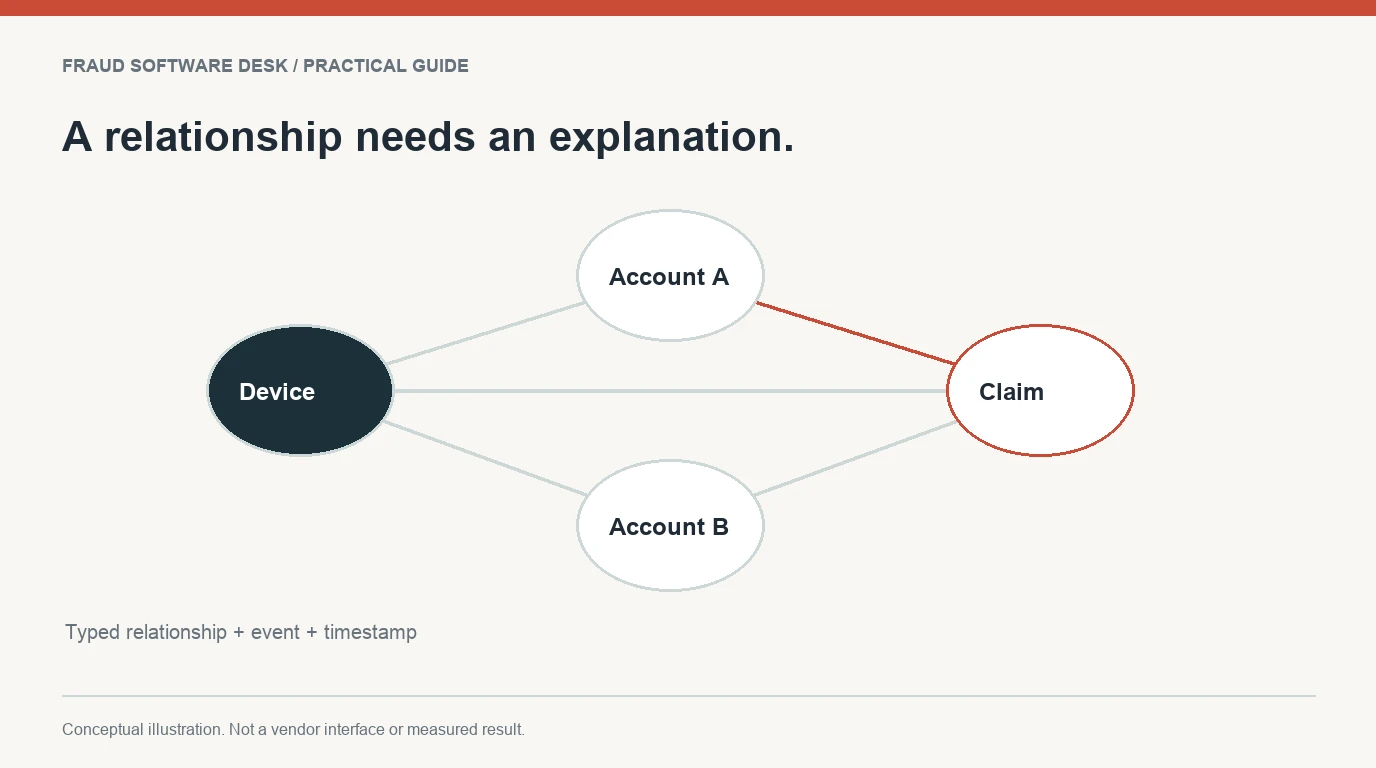
Record where a relationship came from. An authenticated account association, a browser observation and a shared network address carry different evidence. Store the source event and time rather than creating an unexplained permanent link between every related record.
Start from an action that matters
A cluster is useful when it helps answer an operating question: are accounts repeatedly claiming a one-per-person benefit, has a login introduced unauthorized access, or is a payment destination changing across related accounts? Choose the question before creating a global graph.
ShieldLabs supplies ready-made Multi-accounting, Account sharing, Impossible travel and Account takeover findings. These are separate from the general risk verdict. They can give an investigation a defined starting point while the team retains the relevant event and account context.
Describe the relationship, time and evidence
| Relationship | Useful observation | Legitimate control to include |
|---|---|---|
| Account to device | Accounts used the same supported device reference | Household, kiosk or staff-assisted flow |
| Account to session | Authenticated action occurred in the session | Reauthentication and account switching |
| Device to network | Connection changed during related activity | Mobile networks and corporate VPNs |
| Account to payment reference | Authorized token reference appeared across actions | Family cards or business purchasing |
| Event to benefit | A specific entitlement was claimed | Retries, support adjustments and valid renewals |
Use permitted tokenized references where available. Do not copy raw payment credentials into a research graph. Restrict the graph to the data needed for the operating purpose and the system’s data policy.
Inspect velocity without erasing context
A burst of repeated actions can indicate automation or organized abuse. It can also reflect a product launch, a workplace onboarding group or a legitimate family promotion. Compare the action sequence and benefit rules, not only the number of edges.
Use explicit windows. A device shared across accounts over a year has a different meaning from a coordinated claim burst over minutes. Store the time window used by a finding so a reviewer does not mistake an old relationship for a current event.
A small illustrative investigation
Imagine six test accounts claiming the same introductory benefit. Four share a device reference and a repeating action sequence, two use an unrelated shared network. The first group deserves inspection for repeated device-linked activity; the second is not proven coordinated because of its IP alone.
Check authentication, benefit history, session timing and legitimate controls. Preserve which facts support the suspected link. This example explains an investigation pattern; it is not a vendor detection result or a claim about real customers.
Choose the platform for the investigation depth
A ready-made account-abuse layer, a configurable platform and an institutional transaction graph serve different operating needs. SEON’s FAQ describes network analysis for fraud rings; Sift’s Account Defense addresses account-risk workflows. The reviews identify those scopes without assuming every product exposes the same graph or field.
For institutional money movement, Feedzai’s article about network tracing describes cross-bank investigation context. That is not equivalent to a browser-device account link inside a SaaS application. Keep the required data and operating access explicit.
Validate findings and corrections
Store the suspected relationship separately from a confirmed outcome. A reviewer can dismiss a case, confirm abuse or leave it unresolved. An unresolved case should not automatically train another system as fraud. Keep corrections reversible when a shared-device association is found to be legitimate.
Use the false-positive measurement guide to report case outcomes and legitimate restrictions. The API integration guide explains how event references prevent a correct signal from being attached to the wrong account.
FAQ
Does one device with several accounts prove multi-account abuse?
No. Shared hardware can be legitimate. Evaluate the relevant entitlement rules, action pattern and supporting evidence alongside the account relationship.
Why keep IP and device links separate?
An address can be shared by many legitimate users and can change independently of a device. Separate entity types preserve what each observation actually supports.
Can a risk score replace an account investigation?
A score can prioritize review, but the reviewer still needs the relevant entities, events and reasons. A finding should retain its evidence and time context.
Continue reading
- Fraud detection: rules, machine learning and device intelligence
- Fraud detection vs. chargeback guarantee: what you buy
- How to build an iGaming fraud prevention stack
Compare all nine tools or read the complete deployment guide.