Summarize this page with
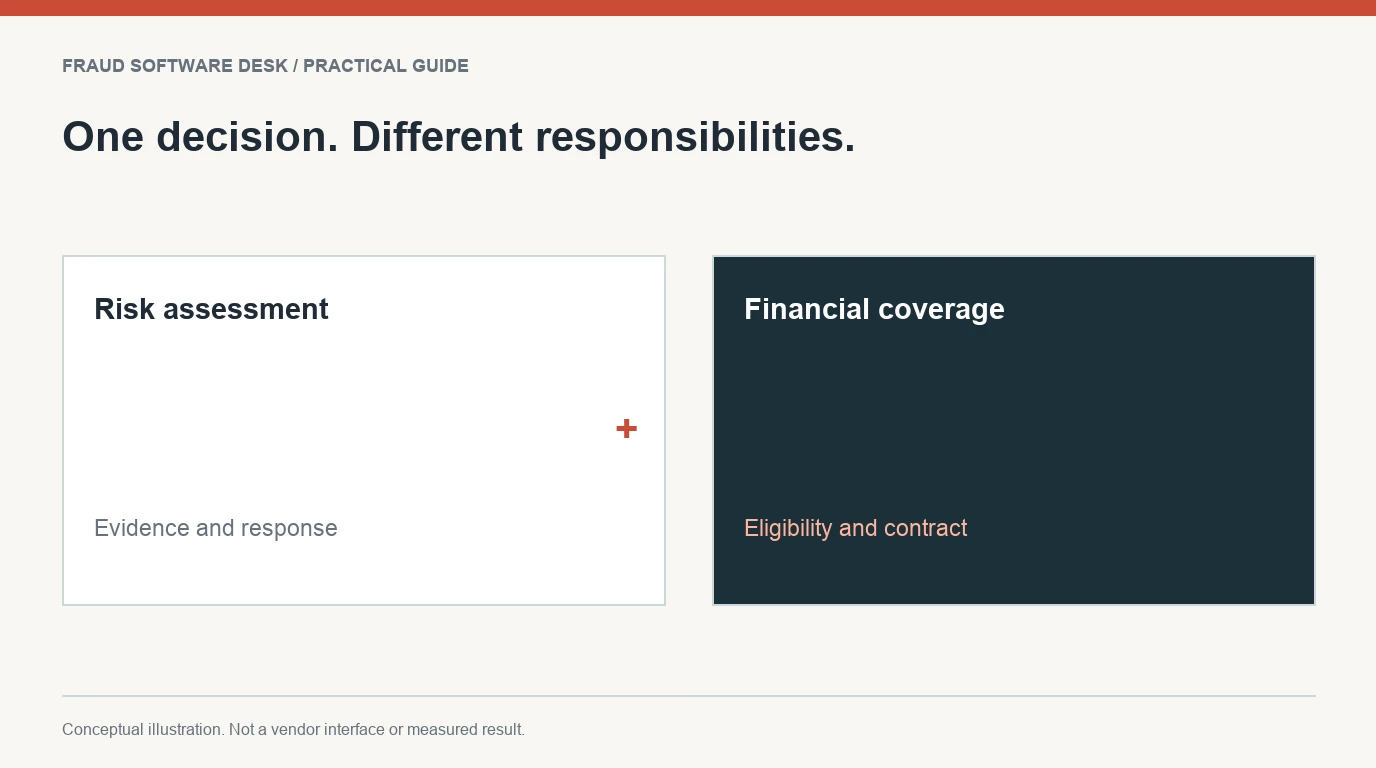
Fraud detection assesses an action. A chargeback guarantee transfers defined financial exposure for eligible approved orders under an agreement. They can be purchased together, but they answer different questions: what should happen now, and who pays if a covered transaction later becomes a loss?
- 1Assess the event
- 2Decide on the order
- 3Check covered loss
Separate detection, decision and financial coverage
A risk service may return a score, reasons or account finding. A commerce decision service may approve or decline an order. A guarantee adds contractual protection for defined outcomes. The same vendor can offer more than one layer, so compare the purchased product rather than a broad company label.
Riskified’s definition describes a guarantee as a contractual obligation associated with approved orders. Read the actual agreement for eligible payment methods, dispute reasons and operating duties. A marketing phrase about protection does not replace those details.
Identify which loss is covered
A stolen-card order, a valid-card promotion abuse case, a non-delivery claim and an account takeover can have different coverage. A guarantee for one type of approved order does not automatically reimburse every loss produced by an account.
| Purchasing question | Detection evaluation | Guarantee evaluation |
|---|---|---|
| What is assessed? | Visit, account, event or transaction | Eligible approved order and covered dispute |
| When is it useful? | Before the protected action | Decision time and later claim handling |
| What output matters? | Reasons, risk and usable findings | Approval, protection status and obligations |
| What is measured? | Detection, friction and availability | Covered loss, reimbursement and uncovered exposure |
| What must be integrated? | Collection, events and result delivery | Order lifecycle, fulfillment and claims data |
Keep both columns if the vendor supplies both. An improved fraud score can reduce loss while a guarantee changes who bears the remaining loss. Neither figure alone describes the complete business effect.
Inspect current commerce product boundaries
Signifyd’s Complete Chargeback Protection addresses fraud and non-fraud disputes within its stated product scope. Its current product range also includes account and session offerings. Ask which package is being quoted and how an order becomes protected.
Forter offers fraud management, account protection and abuse prevention among other products. Riskified also has account and policy products alongside its guarantee. None should be reduced to “checkout only,” and none should be assumed to include every account product in a guarantee quote.
Map the order lifecycle
Trace order creation, authorization, approval, capture, fulfillment, cancellation, refund and dispute. Identify the update expected at each stage, which system owns it and how the merchant proves compliance with the contract. Missing lifecycle updates can change the meaning of protection even when an initial API call succeeded.
Keep a protected/unprotected status attached to each order. Do not infer coverage later from the fact that the vendor returned a risk assessment. Test duplicate updates, late approvals and changed order details during the integration evaluation.
Evaluate false declines alongside covered loss
A guarantee can make a covered loss predictable while unnecessarily declined legitimate orders still cost the business. Report approvals and legitimate restrictions alongside reimbursed chargebacks. Consider the expected contribution margin, not only gross merchandise value.
For an illustrative comparison, two products can reimburse the same covered amount yet approve different legitimate cohorts or require different review work. The observed differences must come from comparable orders and mature outcomes. The evaluation guide explains how to avoid mixing issuer declines with merchant restrictions.
Add account protection where there is no order
A trial credit, referral benefit or unauthorized login may create loss before checkout. A guarantee cannot reimburse a non-existent card transaction. An account and device-risk layer can be useful alongside commerce protection.
ShieldLabs fits that user and repeat-account evidence role through risk, named signals and ready-made account-abuse detections. Evaluate its collection and account association on the protected product flows. A browser checker is a first look at visit evidence; use the testing directory and a complete permitted evaluation before purchasing.
Compare the total operating agreement
Request fee basis, covered reasons, geographic/payment scope, service obligations, claim process and termination handling. Add integration and review costs. Keep recovered disputes distinct from reimbursed guaranteed loss and from loss prevented before the action.
Use the cost guide for the event and order budget. The alternatives page helps choose whether the primary purchase is account detection, operational fraud decisioning, processor-connected risk or commerce financial protection.
FAQ
Is a chargeback guarantee the same as dispute recovery?
No. A guarantee transfers specified exposure under a contract. Recovery services attempt to contest a dispute or recover funds after it occurs; successful recovery is a different outcome.
Does an approved order always have guarantee coverage?
Only if it meets the selected product’s eligibility and contractual conditions. Preserve the actual protection status and required lifecycle records.
Can a merchant use fraud detection and a guarantee together?
Yes. The products can address different checkpoints and responsibilities. Confirm how the integrations interact and avoid treating every vendor result as the same decision.
Continue reading
- How to detect online fraud across the customer journey
- How to evaluate fraud detection and false positives
- How to build an iGaming fraud prevention stack
Compare all nine tools or read the complete deployment guide.