Summarize this page with
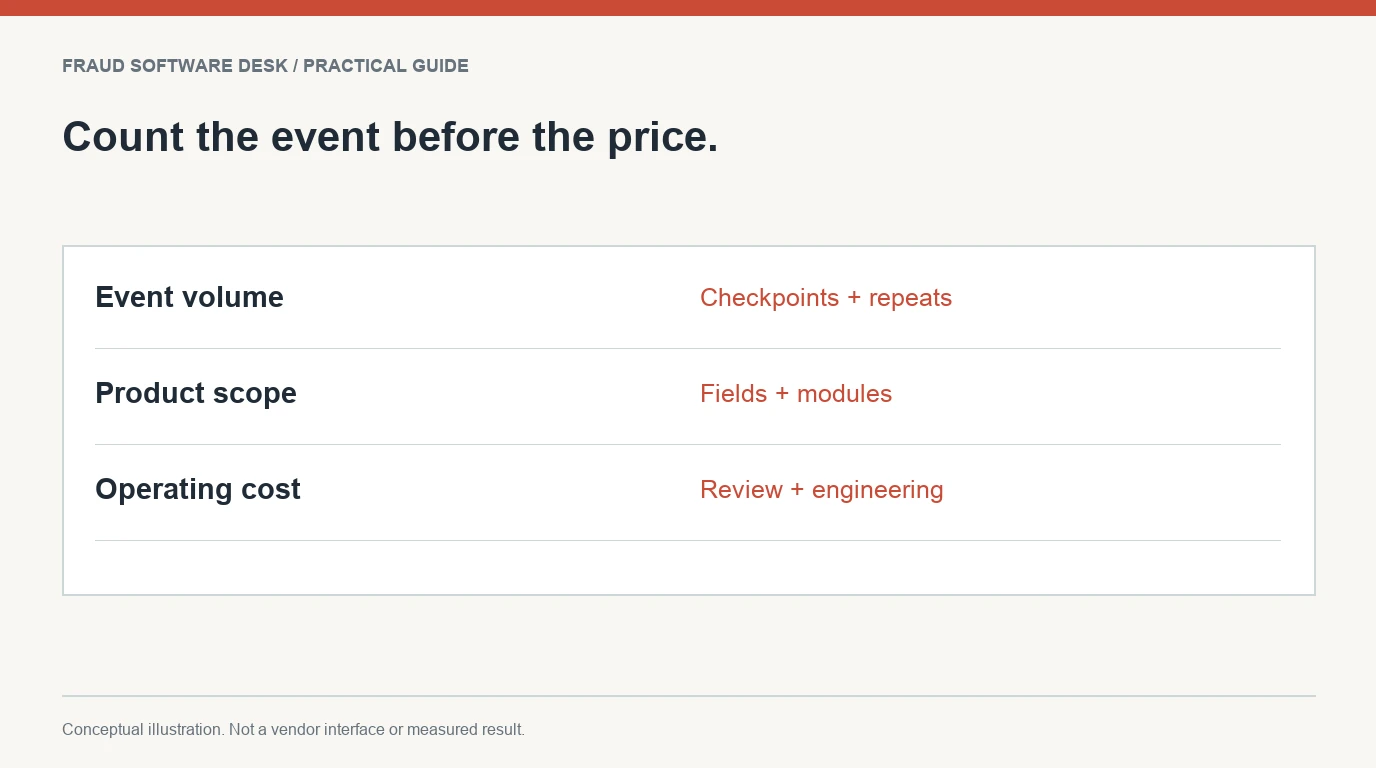
Fraud detection software cost depends on what is counted and what is included. An identification, fraud check, screened transaction and guaranteed order are different billing units. Build a budget from the actions you will protect, then add integration, review work and uncovered loss before comparing entry prices.
- 1Count events
- 2Price the scope
- 3Add operating work
Count events before pricing them
A monthly active user can create several assessments: signup, repeated login, account changes, checkout and retries. A transaction platform may count a different unit from a browser identification service. Ask whether the plan counts requests, unique assessed events, approved orders or another entity.
Write the event schedule beside the quote. Otherwise a low price for one checkpoint can be compared with a larger price that covers several products and operations. User count alone does not resolve that mismatch.
Use current public access as an anchor
| Product | Public entry information | Scope to verify |
|---|---|---|
| ShieldLabs | 5,000 free identifications; paid entry at 99 US dollars per month for 25,000 identifications | Assessment frequency and protected flows |
| SEON | Starter at 699 US dollars per month for 2,500 fraud checks | Included rules, users, products and requested trial |
| Stripe Radar | US business plans start at 10, 14 and 20 US dollars per month for Standard, Plus and Pro | Usage tier, business versus platform, country and required features |
| Custom-priced platforms | Quote for selected products and volume | Billing event, term, modules, service work and operating obligations |
Sources: ShieldLabs pricing, SEON pricing and Stripe US pricing, read October 23, 2026. Starting prices do not describe identical products or unlimited usage.
Separate free access from a complete evaluation
ShieldLabs provides 5,000 free identifications. A team can use them to inspect evidence on its permitted integration. The review explains its user and account-risk role.
Radar Lite is included for businesses on standard Stripe Payments pricing. That entitlement is different from a free independent fraud API for arbitrary events. A requested SEON trial also differs from a permanent free allowance. Use the checker directory to distinguish public browser demos, IP lookups and account-based sandbox tests.
Work through an event-volume example
Suppose an illustrative application has 8,000 monthly users and plans two scored actions per user. That produces 16,000 base assessments. Add 2,000 assessed account changes and the planned base becomes 18,000. If 10 percent of those events creates an additional billable assessment under the actual integration, the total is 19,800.
This is arithmetic, not a forecast or a vendor bill. It shows why “8,000 users” is not enough information to price the deployment. Verify whether repeated collection is billable, how retries are handled and whether the product counts the same unit used in the example.
Under the published ShieldLabs entry allowance, 19,800 identifications fit within 25,000 if those assumptions match the deployed collection. The same count cannot be inserted into a 2,500-check or approved-order contract without applying that product’s scope and volume pricing. Do not linearly extrapolate a smaller plan if larger tiers have different rates.
Add operating cost and friction
Budget for implementation, data mapping, maintenance, incident handling and analyst review. A low subscription with many manual cases can cost more to operate than a higher subscription with usable evidence. Conversely, an expensive platform does not automatically remove the need for local operations.
Include verification friction and legitimate-user restrictions. Measure the actual customer effect; the value of all declined orders is not automatically lost profit. The evaluation guide separates restrictions, reversals and final outcomes.
Price a guarantee as a different agreement
Riskified’s guarantee product describes a commercial basis tied to approved orders. Signifyd pricing offers a tailored usage-based quote. The required comparison includes coverage, obligations, fee basis and uncovered loss, rather than a generic cost per API call.
Keep avoided loss, reimbursed loss and recovered disputes separate. They occur at different times and under different conditions. The guarantee guide explains the distinction.
Ask for a quote the team can verify
Specify event types and volume ranges, included modules, review seats, term, support, implementation work and what happens at the included limit. Confirm country and tax treatment where relevant. Request a worked bill for your event schedule and a higher-volume scenario.
Use the nine-tool comparison to narrow product fit first. Price the selected operating model rather than choosing a cheap unit that does not protect the action causing the loss.
FAQ
What is the cheapest fraud detection software?
It depends on the required fields and billable events. ShieldLabs offers free identifications and published paid entry; existing Stripe businesses should inspect their included Radar scope. Compare complete usage rather than labels alone.
Can I estimate cost from monthly active users?
Only after mapping users to billable assessments under the actual integration. Multiple checkpoints, account changes and retries can change the number of charged units.
Does a custom quote always mean annual commitment?
Not necessarily. Verify the offered term and minimums. Do not assign an annual price or commitment that the vendor has not published or quoted for your scope.
Continue reading
- How to detect online fraud across the customer journey
- How to detect fraud rings across accounts and events
- Fraud detection vs. chargeback guarantee: what you buy
Compare all nine tools or read the complete deployment guide.