Summarize this page with
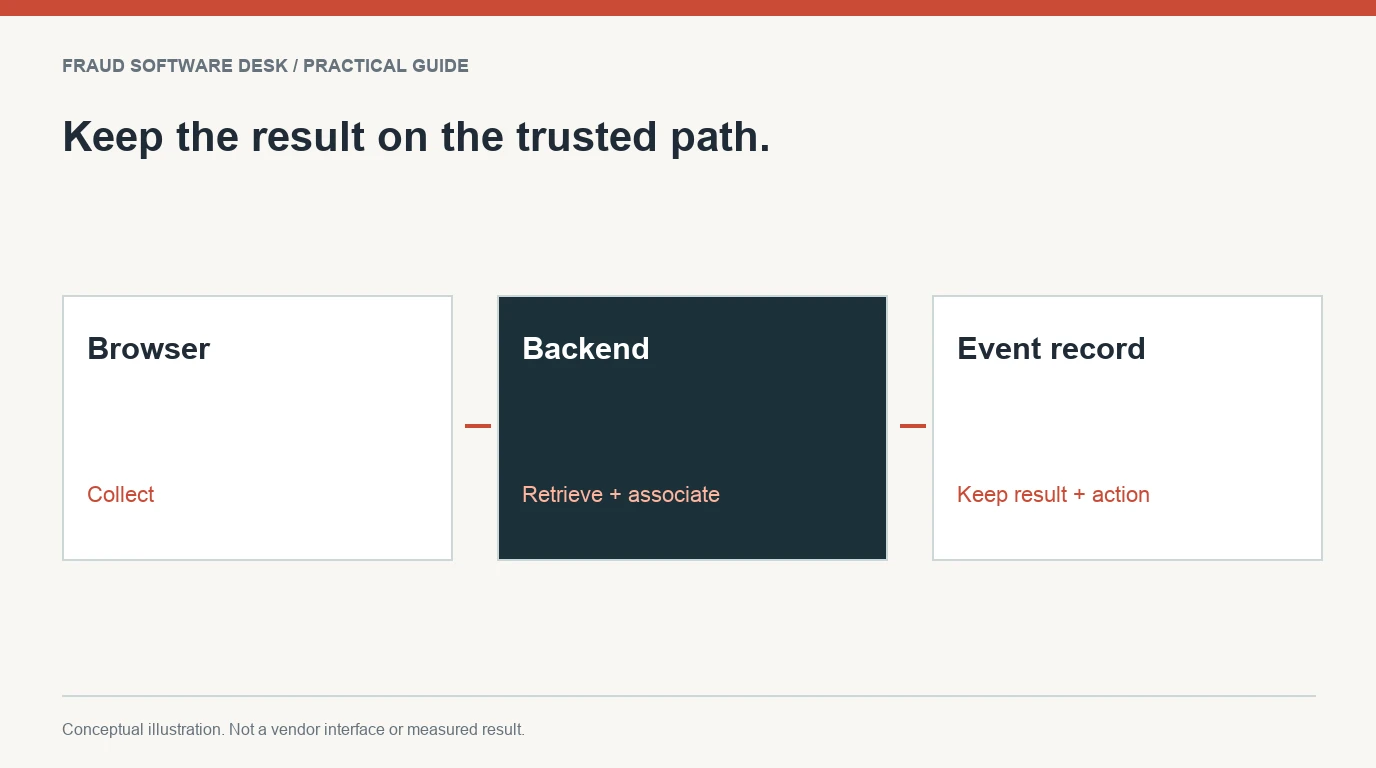
A fraud detection API integration needs more than a successful request. Bind supported collection to the correct account action, retrieve the result through a trusted path and retain the response used for the decision. Define what happens when the result arrives late or cannot be obtained before enabling restrictions.
- 1Collect on the client
- 2Retrieve on the server
- 3Bind to the action
Draw the trust boundary first
The browser can collect supported environment evidence, but a response supplied by an untrusted client should not automatically become the server’s final assessment. Keep secret API credentials out of browser code and use the vendor’s documented verification or server-retrieval flow.
Client and server SDKs have different roles. A server SDK does not imply that browser evidence can be collected without a client. Conversely, a visible client identifier is not the same thing as a private credential. Follow the current integration contract for the selected product.
ShieldLabs documentation provides collection and delivery context; Sift’s developer reference describes event-based integration. Do not copy payload fields between products because both call their output a risk score.
Attach the result to an immutable event
Use your own event reference for the protected action and preserve the vendor’s result reference alongside it. An authenticated account ID, a visitor ID and an order ID are different entities. Keep the timestamp and action type so later investigation does not infer the wrong relationship.
The following is an application-side record design, not a vendor API response:
{
  "event_id": "evt_example_1042",
  "event_type": "account_change",
  "account_ref": "test_account_42",
  "observed_at": "2026-10-23T12:00:00Z",
  "assessment_ref": "provider_result_reference",
  "assessment_state": "available",
  "response_action": "review",
  "integration_version": "evaluation-1"
}
The final action should refer to the event and assessment actually used. Do not overwrite the original record when new evidence arrives later. Store a later update with its own time and relationship.
Match collection to the risky checkpoints
Signup, login, account changes, checkout and payout can require different input data. Use the supported collection surface and account association for each. A browser demo supplies an initial visit; it does not reconstruct an account’s historical activity.
Stripe’s test-mode documentation explains a payment testing environment. The separate Radar testing guide exercises documented risk-related behavior. Use synthetic test data and keep it separate from production credentials and live transactions.
Design failure handling before enforcement
| Failure | Record | Operating question |
|---|---|---|
| Collection missing | Missing evidence state and surface | Which protected actions can continue or require verification? |
| Result timeout | Deadline and unavailable result | Can the application retry without duplicating the action? |
| Duplicate webhook | Result/event reference and delivery record | Will the repeated delivery repeat a restriction or benefit grant? |
| Late assessment | Assessment time and original action | Does it support later review rather than an earlier decision? |
| Invalid association | Event and account mismatch | Can the action be paused until the relationship is verified? |
Do not label a timeout as a low-risk customer. Do not label it as confirmed fraud either. The application needs an explicit unavailable-result path appropriate to the value and timing of the action.
Make retries and webhooks safe
Where delivery retries are supported, process the same assessment idempotently. Keep a record of the event/result pair and the action already applied. Validate delivery through the vendor’s documented authentication mechanism rather than inventing a signature header.
A callback arriving before an application transaction commits can create a race. Decide how the integration reconciles pending events, late events and repeated deliveries. Test these paths with controlled data; they are often more consequential than a successful happy-path response.
Preserve reasons and final outcomes
Retain the fields needed for investigation under your data policy. These can include assessed entity, risk reasons, relevant identity references, result time and response version. Keep a confirmed account-abuse finding separate from a generic high score.
Send supported outcome feedback where the product requires it. A review not completed should not automatically become a fraud label. Use the measurement guide for label confidence and delayed outcomes, and the account-ring guide for typed relationships.
Release against a fixed checklist
Verify supported browsers and apps, missing collection, load bursts, retry behavior, event association, result access and customer recovery. Count how many assessments each protected action creates before committing to a plan. The pricing guide shows why monthly user count is not enough.
Start with the checker directory to inspect output types. Then evaluate the chosen fraud tool on permitted events with the actual production-shaped integration and an explicit rollout owner.
FAQ
Can the browser send the final risk score to my backend?
Use the vendor’s trusted retrieval or verification design. A client-supplied value alone can be modified and should not replace authenticated server-side evidence.
Should the same event be checked twice after a timeout?
A retry policy depends on the API contract and action. Preserve event references and idempotent action handling so a retry does not create duplicate side effects or misleading counts.
Does a sandbox result prove production fraud accuracy?
No. It verifies selected integration behavior with test data. Detection performance needs a permitted representative cohort and independent outcomes.
Continue reading
- Fraud detection software cost: free tools and billing units
- How to detect fraud rings across accounts and events
- How to build an iGaming fraud prevention stack
Compare all nine tools or read the complete deployment guide.